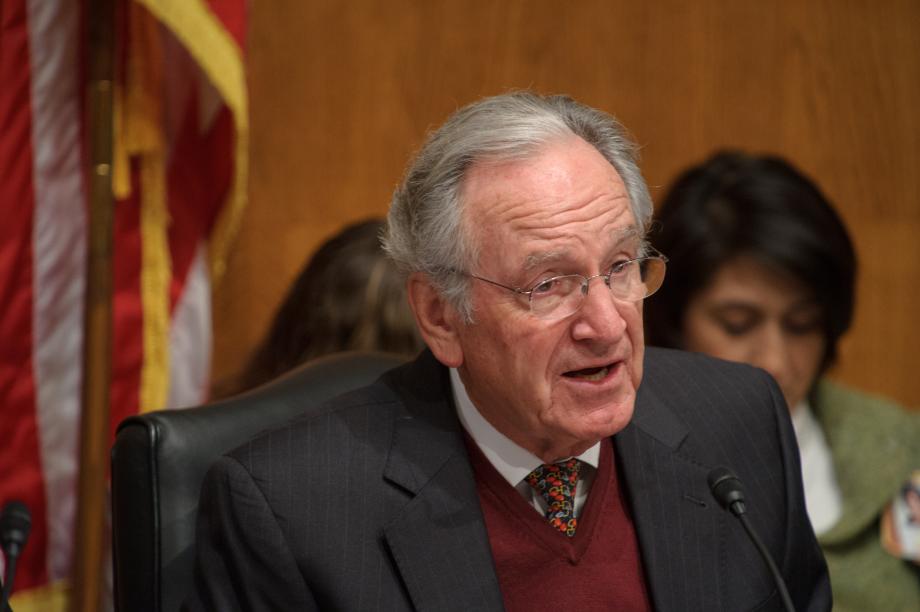
It will be an incredible honor and immense responsibility to appear this Tuesday morning before the United States Senate Committee on Health, Education, Labor, and Pensions for a hearing about college affordability. I am especially happy that the focus of this hearing is on the perspectives of students and families, since they view policy as enacted, not policy as intended.
The hearing will be webcast here beginning at 9 am Central/ 10 am Eastern. My written testimony has been submitted and will be posted on the website following the hearing-- it is substantially longer and more detailed than my oral testimony, since I only get 5 minutes for that.
This committee is chaired by Senator Tom Harkin, and (be still my heart!) includes both Senator Tammy Baldwin and Senator Elizabeth Warren. I'm told they will both be present, and that Senator Baldwin will deliver my introduction.
I will be joined by a representative from the U.S. PIRG and two students. I look forward to this important conversation, and hope that you'll join me in it by tweeting to me @saragoldrickrab
I'll post some reactions and talk a bit about this uncommon experience after the hearing. After my heart stops pounding, of course.
Grading as the New Battlefield
This guest post is authored by R. Thomas, a graduate student at the University of Wisconsin-Madison.
Grading might not be the most exciting aspect of a teacher’s career but it might be one of the best sources of job security - particularly in light of proposed online courses with automated grading that aim to put professors out of work or into unappealing, low-wage, jobs.
Of course we’ve heard a lot about online education, MOOCs, merit badges, and competency assessments. As Clayton Christiansen describes it, universities save money with online education simply because there is a glut of PhDs. For years graduate schools have been over producing the amount of PhDs. Consequently talented instructors are more than willing to teach courses at low wages, with no benefits, and with essentially no job security. As he writes in The Innovative University,
One might hope that this is just a minority view, a freakish nonrepresentative example. In fact you might say that there are structural barriers to the spread of online education: instructors are simply needed to grade students’ essays and exams. Unfortunately widespread changes might not be so unlikely. Yesterday a New York Times article described an effort to go beyond multiple-choice and actually automate the grading of essays. The vision is that a few superstar lecturers will deliver content to hundreds of thousands of students, whose grades will be established by a computer. To say nothing of whether the computer can actually grade an essay, one can imagine the impact on jobs for PhD’s. Another article from the Chronicle of Higher Education described a similar vision. The State of California has proposed a new university that requires no coursework whatsoever. Students simply need to take multiple-choice exams to receive a degree.
American higher education is commonly characterized as unique among industries in having missed the technological revolution. Universities have simply not garnered the productivity gains that other industries have received, mainly because teaching cannot be automated. Consequently college is exceptionally expensive. Advocates for greater access and cheaper prices maintain admirable positions; however the question remains who will pay for greater access and cheaper tuition. Many students cannot afford to pay for it, the private sector will not pay for it, and the states will not pay for it. Such efforts as described in the New York Times and the Chronicle suggest a technological solution. Many professors are to be replaced by machines, just as factory workers were replaced by robots. Maintaining control of grading is one way of preventing this change. Indeed, ownership of grading may soon become a major battleground for American professors and it seems that at least some of the American professoriate is rising to the challenge.
Grading might not be the most exciting aspect of a teacher’s career but it might be one of the best sources of job security - particularly in light of proposed online courses with automated grading that aim to put professors out of work or into unappealing, low-wage, jobs.
Of course we’ve heard a lot about online education, MOOCs, merit badges, and competency assessments. As Clayton Christiansen describes it, universities save money with online education simply because there is a glut of PhDs. For years graduate schools have been over producing the amount of PhDs. Consequently talented instructors are more than willing to teach courses at low wages, with no benefits, and with essentially no job security. As he writes in The Innovative University,
“Adjunct instructors give the online educators two advantages. Rather than receiving an annual salary, as full-time faculty at traditional universities do, online instructors are paid by the course. This means that the online university can match teaching supply to student demand - the instructor is hired, or contracted for, only when it class is likely to have enough students to generate an operating profit. Also, an online instructors teaching performance is easily monitored, and an underperformer has no contractual right to further employment.” (page 213)According to this view, it will be a lower class of underpaid instructors that will help bring higher education to the masses at a cheaper cost. It is a Wal-Mart version of higher education- a vision that combines both inexpensive education and legions of poorly paid instructors.
One might hope that this is just a minority view, a freakish nonrepresentative example. In fact you might say that there are structural barriers to the spread of online education: instructors are simply needed to grade students’ essays and exams. Unfortunately widespread changes might not be so unlikely. Yesterday a New York Times article described an effort to go beyond multiple-choice and actually automate the grading of essays. The vision is that a few superstar lecturers will deliver content to hundreds of thousands of students, whose grades will be established by a computer. To say nothing of whether the computer can actually grade an essay, one can imagine the impact on jobs for PhD’s. Another article from the Chronicle of Higher Education described a similar vision. The State of California has proposed a new university that requires no coursework whatsoever. Students simply need to take multiple-choice exams to receive a degree.
American higher education is commonly characterized as unique among industries in having missed the technological revolution. Universities have simply not garnered the productivity gains that other industries have received, mainly because teaching cannot be automated. Consequently college is exceptionally expensive. Advocates for greater access and cheaper prices maintain admirable positions; however the question remains who will pay for greater access and cheaper tuition. Many students cannot afford to pay for it, the private sector will not pay for it, and the states will not pay for it. Such efforts as described in the New York Times and the Chronicle suggest a technological solution. Many professors are to be replaced by machines, just as factory workers were replaced by robots. Maintaining control of grading is one way of preventing this change. Indeed, ownership of grading may soon become a major battleground for American professors and it seems that at least some of the American professoriate is rising to the challenge.
The Wisconsin Idea: Student Fee Allocation Norms in Wisconsin Surfacing in Other Big 10 Schools
This post is authored by Maria K. Giannopoulos, Vice Chair of the Associated Students of Madison at the University of Wisconsin-Madison. She can be reached at mgiannopoulo@wisc.edu
In an article published by the Chronicle of Higher Education earlier this week, Anil Wadhwani of Northwestern and Jonathan Green of Cambridge describe how the Northwestern University administration is giving students a voice in the college budget process.
To some, giving students a voice regarding the use of their fees may be a no-brainer, but at many institutions administrators and staff unilaterally decide the distribution of fees and ideas for student services. The authors cite "shortsighted vision" and high student turnover as possible reasons to limit student engagement in the fee process. But at Northwestern, administration finally realized that despite these potential issues, student input was valuable and attainable.
In Wisconsin, our conception of student power is even stronger. The power of allocating and deciding on the use of fees is codified in state statute and in University of Wisconsin (UW) system policy. Chapter 36.09(5) in state statute declares, “Students shall have the primary responsibility for the formulation and review of policies concerning student life, services, and interests." Under Financial Policy 50, set by the UW System Board of Regents, Segregated University Fees (SUF) are allocated by students in consultation with the chancellor and subject to the final confirmation of the Board of Regents, in accordance with the statue mentioned above.
The system afforded by Wisconsin’s higher education governing documents highlights the shared governance that we students, faculty, staff, and administration use to make decisions. When all voices are present at the table, an outcome more fitting of the representative groups comes to fruition, rather than decisions made in the absence of key stakeholders. In the case of student fees, students allocate money to student groups and services. Who knows better than students about the needs and requirements of student life and services? No one.
Wadhwani and Green note that the committee at Northwestern is one that mirrors the SUF Allocation Committees across the state of Wisconsin. “The committee isn't a focus group, and it doesn't merely rubber-stamp the decisions of higher-ups. Rather, it allows Northwestern students to suggest concrete solutions to real problems with the undergraduate experience.”
This is a promising victory for student power in private colleges. Northwestern is the only private university within the Big 10, although University of Michigan and Penn State have private roots. Even though many private universities do have student input, they may only be bound to Trustees or a Board of Directors instead of a state statute or Board of Regents like we have in Wisconsin. The same could also be said for public institutions in other states nationwide.
Students in Wisconsin have a voice on how their money is spent, and it's about time that other institutions emulate the model we have here.
The MOOC Industrial Complex (Part II)
About a month ago I began writing about the MOOC Industrial Complex. As expected, it's growing rapidly. Today's NY Times tells us that soon computers will be grading essays at the college level.
Not only will those brainy professors be replaced by technology, but heck even better, the computer will give you a "retake" so you can try and improve your grade! Gee, how lovely. The creator even emphasizes the importance of that immediate feedback and instant gratification, since (oh my goodness!) students currently have to wait days-- or even weeks!!-- for their essays to be graded.
It won't be long now, we're told, as the system is "nearing the capability of human graders."
Watch out you graduate students and professor-- the machines are coming...
Just wait, as one of my favorite Twitterers Siva Vaidhyanathan writes, for the students to line up at the computers' office hours (??) to protest and renegotiate their grades.
Not only will those brainy professors be replaced by technology, but heck even better, the computer will give you a "retake" so you can try and improve your grade! Gee, how lovely. The creator even emphasizes the importance of that immediate feedback and instant gratification, since (oh my goodness!) students currently have to wait days-- or even weeks!!-- for their essays to be graded.
It won't be long now, we're told, as the system is "nearing the capability of human graders."
Watch out you graduate students and professor-- the machines are coming...
Just wait, as one of my favorite Twitterers Siva Vaidhyanathan writes, for the students to line up at the computers' office hours (??) to protest and renegotiate their grades.
Those Selfish PhD Candidates
One of the most stunning moments in the recent Ed Talks Wisconsin came towards the end of a Friday night discussion about MOOCs. The room was heavily populated with graduate students, many of whom were asking about the implications of these online courses for their employment prospects. With the decoupling of teaching from their future responsibilities, many were (rightly) worried about how they'd be trained, funded, and what they'd do post degree.
As one student put it,"What's the incentive for the next generation of scholars to pursue a PhD?"
In response to that question, the Chancellor of the UW Colleges, Ray Cross, responded this way:
"Is your goal to get a PhD, or is your goal to change education?"
Many in the room looked up, confused about whether he was serious.
Well, an email that just arrived from UW-Madison suggests he was. The newsletter it included contained the following key blurb:
"New program trains students to create online courses. With the advent of online courses and degrees, a new program will teach students how to provide online course support. Student Online Course Support (SOCS) will help students find campus tech-related jobs, expose them to new career paths, and save the University funds by hiring student support. Tell your students about this opportunity."
Got that? It's full-speed ahead in support of the Flex Degree and the MOOCs here at Madison; above I linked to the course description that explicitly references these programs. Want a campus job? Get on board. And be sure, of course, to save the university money!
Will this next become a mandated part of our graduate training? Or will we no longer need those folks, as our younger Badger are trained and ready to serve?
ps. The video of Cross starts around the 1:32 minute mark.
As one student put it,"What's the incentive for the next generation of scholars to pursue a PhD?"
In response to that question, the Chancellor of the UW Colleges, Ray Cross, responded this way:
"Is your goal to get a PhD, or is your goal to change education?"
Many in the room looked up, confused about whether he was serious.
Well, an email that just arrived from UW-Madison suggests he was. The newsletter it included contained the following key blurb:
"New program trains students to create online courses. With the advent of online courses and degrees, a new program will teach students how to provide online course support. Student Online Course Support (SOCS) will help students find campus tech-related jobs, expose them to new career paths, and save the University funds by hiring student support. Tell your students about this opportunity."
Got that? It's full-speed ahead in support of the Flex Degree and the MOOCs here at Madison; above I linked to the course description that explicitly references these programs. Want a campus job? Get on board. And be sure, of course, to save the university money!
Will this next become a mandated part of our graduate training? Or will we no longer need those folks, as our younger Badger are trained and ready to serve?
ps. The video of Cross starts around the 1:32 minute mark.
Advice for Chancellor Blank from a UW Employee
This afternoon I received the following email from a UW employee who, unlike myself, does not enjoy tenure and thus prefers to convey this advice to the incoming chancellor anonymously. I recognize and sympathize with that concern, and thus am simply reprinting it here in full. I believe this advice, coming from someone with plenty of experience at the institution, is worth full consideration. If you have your own words of advice to share, please send them along!
Dear Dr. Goldrick-Rab –
If Dr. Blank is willing to listen to you, and I hope she does, one thing you might want to suggest is that she does not start calling herself “Becky” but instead be referred to as Rebecca when she wants to go “casual.”
David Ward was never been referred to by anyone as “Dave,” and if John Wiley had a nickname or pet name as a child, he certainly did not use that on his official correspondence or when he was quoted in the press. This is, after all, the University of Wisconsin-Madison. Excellence in teaching and research is how we convince people to give us their money or send us their children to educate.
Trying to be cute or folksy is not what the alumni, citizens, or corporate and foundation donors are looking for. Two of my children were enrolled at UW-Madison when “Biddy” was the Chancellor, and neither one of them understood where the widely reported “love” that all the students at Wisconsin supposedly had for Biddy came from.
Thank you.
Keep An Eye On....
Several elements in today's news caught my eye. Here are things worth watching more closely...
... A Tennessee bill that would link Temporary Aid to Needy Families to poor children's school performance. Senate Bill 132, which appears to have legs, would cut up to 30% of a family's cash assistance if a child in the family failed to meet satisfactory academic progress in school. This approach is consistent with a policy trend towards individualizing societal problems and blaming victimless children and their families for collective failures to protect "we" the people.
...Trends in student fees. While most of the country is tracking rising tuition, how many people realize that institutions can fairly easily raise revenue while escaping scrutiny by leaning on fees? What are the links between rising student fees and efforts by colleges and universities to "pay for the party" that they think upper-class students demand?
...Year Up. According to a new report from the UW-Madison Institute for Research on Poverty, an evaluation this popular program is producing some evidence of success, though not with regard to college outcomes. Since it's visibly implemented on campuses including Miami Dade College, I'm eager to see the longer-run evaluation findings and whether these findings are used in considering further program development.
... A Tennessee bill that would link Temporary Aid to Needy Families to poor children's school performance. Senate Bill 132, which appears to have legs, would cut up to 30% of a family's cash assistance if a child in the family failed to meet satisfactory academic progress in school. This approach is consistent with a policy trend towards individualizing societal problems and blaming victimless children and their families for collective failures to protect "we" the people.
...Trends in student fees. While most of the country is tracking rising tuition, how many people realize that institutions can fairly easily raise revenue while escaping scrutiny by leaning on fees? What are the links between rising student fees and efforts by colleges and universities to "pay for the party" that they think upper-class students demand?
...Year Up. According to a new report from the UW-Madison Institute for Research on Poverty, an evaluation this popular program is producing some evidence of success, though not with regard to college outcomes. Since it's visibly implemented on campuses including Miami Dade College, I'm eager to see the longer-run evaluation findings and whether these findings are used in considering further program development.
Subscribe to:
Posts (Atom)