I know we in Wisconsin are sick and tired of hearing about Virginia....but please bear with me, because a new report out of UVA will likely resonate-- especially with my UW-Madison readers.
A new Lumina Foundation-funded report from the Miller Center and the Association of Governing Boards of Colleges and Universities, based on a December 2010 meeting about "how to maximize higher education’s contributions to the American economy" makes the following provocative statement:
The past few decades have seen far too many colleges and universities engage in a rush toward elite status. The more selective an institution is, the better. The more research money it collects, the better. The higher it ranks in national and international publications, the better. But what has the race for status contributed to the public good? It is possible to build state institutions that are noted in U.S. News & World Report and national rankings of research universities but ignore the needs of many or most of a state’s people.
Among the report's recommendations:
(1) Rethink the purpose and functions of governing boards (e.g. like our Board of Regents). Give them new leadership roles, including setting clear goals for their member institutions and creating funding mechanisms linked to these goals. "The state governing and coordinating boards are still needed, both for their leadership and for the “buffer” role that they play between higher education institutions and state governments...In addition to measuring and paying for performance, state boards should encourage institutional redesign, curriculum revision, and the introduction of educational programs.. that meet the needs of new kinds of students...State boards should promote review of the missions of institutions,and create conditions in which it is in their own best interests to focus on the public mission of higher education...Reconsidering the missions of colleges and universities requires participation by faculty, institutional management, institutional governing bodies, and those who are responsible for the statewide coherence of higher education. It also requires consultation with the executive and legislative branches of government, with employers, localities, and the business community in general."
(2) Assign greater percentages of [institutional] operating budgets to instruction in order to achieve higher rates of degree completion. "The percentage of increases in student tuition over the past several years is far greater than the increases in expenditures on instruction. Where is the money going? What expenditures can be reduced or eliminated?...Many institutions have grown used to spending their money on things that may not reflect the needs of the states or regions that they are supposed to serve."
(3) Increase faculty teaching responsibilities. "Reduce the number of non-permanent and adjunct faculty -- this almost certainly will require that many regular, full-time faculty members teach more courses and be relieved of other duties for which they have volunteeredor to which they have been assigned."
(4) Restrict research efforts to a limited number of institutions. "..Say clearly that the “research” obligation of the great majority of faculty members is simply to remain current in their fields. Relatively few of them are going to make historic contributions to human knowledge."
(5) Adopt tighter, more focused curricula with key learning objectives."..The “electives” that have proliferated in the past half-century often are far less cost-effective, in part because enrollment in them is voluntary and usually smaller, and not required for particular programs of study. A core curriculum of required courses may seem less attractive than a wide array of choices, but it also may be less costly and more focused on key learning objectives. It is also likely to lead to higher levels of program completion."
(6) "Institutions should be required to assess what students learn and to measure and report their progress in clear and unambiguous terms."
Now, I don't agree with every idea in here-- but I do think this is a very useful report for framing a discussion about the future of Wisconsin public higher education, and I urge you to review it in full.
Let the Sunshine In

Evidence-based decision-making requires data. We can disagree over the merits of using evidence to make decisions and we can also worry about the quality of the data collected, but if we hope to ground decisions in facts we need data.
As all higher education researchers know, there are enormous barriers that prevent the use of data in decision-making about program effectiveness. Think it's difficult to study the k-12 system? Come over to the dark side sometime, where de-centralized colleges and universities get to act independently when making decisions about granting data access, and nearly all find some convoluted way to hide behind FERPA.
Oh FERPA, that big hairy monster that claims to protect students' rights by shielding them from the benefits of evidence-based practices. Paying skyhigh tuition to your college while assuming they have ensured the way they teach actually "works"? Think again--- in all likelihood, the only people who've looked at the data are on the inside; administration-paid institutional researchers who are over-worked and underpaid, and most importantly tasked with responding to administrator whims and reporting requirements-- leaving little time for deep, thoughtful inquiry.
FERPA is very often used to deny external researchers access to student record data. Most often, we are simply told "Can't. FERPA doesn't allow it." "Oh that FERPA, that silly, silly FERPA. We WANT to give you the evidence we're doing a great job, but sorry, can't compromise student privacy."
Most of this is completely bogus, and thankfully the Data Quality Campaign has been working to reform FERPA, bringing it into the 21st century with all of its security protections. Back in April DQC had a big win, when the Department of Education released new proposed amendments to FERPA. The changes would "facilitate fuller access for research and evaluation purposes to student data contained in state longitudinal data systems (SLDSs) in order to increase accountability and transparency for educational outcomes and to contribute to a culture of innovation and continuous improvement in education, while at the same time enhancing privacy protections through expanded requirements for written agreements as the basis for disclosures of data and US ED enforcement mechanisms. They would authorize fuller, more cost effective use of state-level student data for research, evaluation, and accountability, subject to clear privacy protections, as well as effective use of data across all levels of education to evaluate and improve education programs."
Rock on! This was simply an excellent step.
Oh but wait-- here comes Dupont Circle. This morning, around 30 higher education associations released a letter objecting to the proposed regs. They are all for research, they say, but the privacy protections aren't strong enough.
Why am I not surprised? I hate to be so cynical, but if these associations really were supportive of the main reform goals, the letter could have begun with much stronger, clearer statements about the need for higher education to benefit from research-based practices, and denouncing the historical resistance to that culture. The privacy concerns could then be framed as necessary modifications to "make this work"-- instead, the letter comes off as weak whining at best, and typical platitudes about protecting student privacy at worst.
In recent years I've watched brave colleges and universities step up to facilitate external research and integrate it into their practices. The University of Wisconsin System and the Wisconsin Technical Colleges are among them. Let's hope their national associations get on board.


What Wisconsin Needs Now: Collective Efficacy
When citizens seek to solve social problems, they are much more effective if they work together rather than alone. This basic, sensible idea is also known as "collective efficacy." And it is what must be inculcated in Wisconsin residents if we are to preserve our world-class public higher education systems.
Our willingness to act, when needed, for one another's benefit, generates long-lasting effects. Unfortunately, there is a strong impulse to turn inward when threatened, to focus on self-preservation rather than community preservation.
Solutions for issues like the fiscal challenges facing the University of Wisconsin System will not emerge if we follow leaders with imperious styles who seek to "win" no matter what the cost. Regardless of the specific policy agenda, the process of policy formation is essential since it dictates the terms of the debate.
This may sound exceedingly feel-good, but it is also deeply pragmatic. The savings that will accrue to individual campuses from any "flexibilities" are small (numbers provided to me by Darrell Bazzell are in the $10-20 million range for Madison) but collectively (if granted to all campuses) fairly large. The same is true for proposed efficiencies such as adjustments in faculty/student ratio. If, as a community, UW System examined that key cost driver across departments and divisions throughout all institutions, it could reasonably begin to make assessments about resource distribution. I suspect that some departments at UW-Madison would actually see that ratio decreased as a result, perhaps because of resources saved at another campus-- and vice versa.
The climate at UW Madison has eroded dramatically over the course of several recent policy debates such as the Madison Initiative for Undergraduates, the Graduate School Restructuring, the Huron Engagement, and now the New Badger Partnership. Faculty, staff, and students are fearful of repercussions from both the success and/or the failure of the NBP. Rumors of the imminent departure of our friends and colleagues fly around daily. Motivation and productivity are down.
The way forward lies in refocusing on what has always made Madison -- and System -- great. That is: our commitment to a community that prioritizes fearless sifting and winnowing and shared decision-making to a degree uncommon in other institutions of higher education. That's the community and commitment that put us on the map. We have been through hard financial times before, and inevitably will go through them again. Stick to what we do best, and what we can do best no matter how many dollars we have at the moment, and we will shine.
Our willingness to act, when needed, for one another's benefit, generates long-lasting effects. Unfortunately, there is a strong impulse to turn inward when threatened, to focus on self-preservation rather than community preservation.
Solutions for issues like the fiscal challenges facing the University of Wisconsin System will not emerge if we follow leaders with imperious styles who seek to "win" no matter what the cost. Regardless of the specific policy agenda, the process of policy formation is essential since it dictates the terms of the debate.
This may sound exceedingly feel-good, but it is also deeply pragmatic. The savings that will accrue to individual campuses from any "flexibilities" are small (numbers provided to me by Darrell Bazzell are in the $10-20 million range for Madison) but collectively (if granted to all campuses) fairly large. The same is true for proposed efficiencies such as adjustments in faculty/student ratio. If, as a community, UW System examined that key cost driver across departments and divisions throughout all institutions, it could reasonably begin to make assessments about resource distribution. I suspect that some departments at UW-Madison would actually see that ratio decreased as a result, perhaps because of resources saved at another campus-- and vice versa.
The climate at UW Madison has eroded dramatically over the course of several recent policy debates such as the Madison Initiative for Undergraduates, the Graduate School Restructuring, the Huron Engagement, and now the New Badger Partnership. Faculty, staff, and students are fearful of repercussions from both the success and/or the failure of the NBP. Rumors of the imminent departure of our friends and colleagues fly around daily. Motivation and productivity are down.
The way forward lies in refocusing on what has always made Madison -- and System -- great. That is: our commitment to a community that prioritizes fearless sifting and winnowing and shared decision-making to a degree uncommon in other institutions of higher education. That's the community and commitment that put us on the map. We have been through hard financial times before, and inevitably will go through them again. Stick to what we do best, and what we can do best no matter how many dollars we have at the moment, and we will shine.
It's All About the Faculty: Update
On April 25 I blogged about the claim made by some NBP proponents that the policy change was needed in order to stem the tide of faculty turnover at UW-Madison. In that post I referred to some data from a 1999 report, which at the time was all I could locate on the web.
I have now had the opportunity to examine more recent data (UW-Madison faculty have access to it at the APA website) and here are some updates:
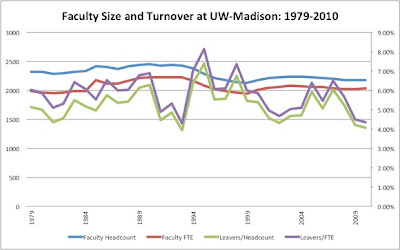
(1) In the prior post, I claimed that there hadn't been much change over time in turnover rates at Madison. As I said, I was looking at data up til 1999 and it showed a rate of about 5 or 6% (based on number of leavers divided by total number of faculty). The more recent data shows even lower turnover rates since that time-- no doubt due in large part to the efforts of UW Administration and the fact that the 2005-07, 2007-09 and 2009-11 biennial budgets provided High Demand Faculty Retention Funds (HDFRF) to address recruitment and retention issues. In the graph below, the blue and red lines show the number of faculty (blue is headcount and red is FTE) and green and purple show the turnover rate calculated two ways (green by dividing # leavers by headcount, and purple dividing #leavers by FTE). As you can see, there's no evidence that our turnover is climbing.
(2) The percent of our faculty receiving outside offers declined during the 1980s and 1990s (from a high of 7.7% in 1983 to a low of 2.4% in 1999) and then grew again during the 21st century to a high of 8.1% in 2009. However, after a steady decline in the 1990s, our success at retaining faculty who receive offers has increased from 60% in 2001 to 84% in 2008 and 80% in 2009.
(3) Probably due to the state support in this area, the percent of payroll devoted to these retention offers declined from up to 10% in the 1980s to barely 1% in 2009.
It certainly seems that those funds from the state helped stave off an uptick in faculty turnover rates. What isn't clear is that the NBP--and the Public Authority model in particular-- is necessary in order to continue to use funds in this manner. In 2009-2010 we spent less than $1.5 million on this effort.
I have now had the opportunity to examine more recent data (UW-Madison faculty have access to it at the APA website) and here are some updates:
(1) In the prior post, I claimed that there hadn't been much change over time in turnover rates at Madison. As I said, I was looking at data up til 1999 and it showed a rate of about 5 or 6% (based on number of leavers divided by total number of faculty). The more recent data shows even lower turnover rates since that time-- no doubt due in large part to the efforts of UW Administration and the fact that the 2005-07, 2007-09 and 2009-11 biennial budgets provided High Demand Faculty Retention Funds (HDFRF) to address recruitment and retention issues. In the graph below, the blue and red lines show the number of faculty (blue is headcount and red is FTE) and green and purple show the turnover rate calculated two ways (green by dividing # leavers by headcount, and purple dividing #leavers by FTE). As you can see, there's no evidence that our turnover is climbing.

(2) The percent of our faculty receiving outside offers declined during the 1980s and 1990s (from a high of 7.7% in 1983 to a low of 2.4% in 1999) and then grew again during the 21st century to a high of 8.1% in 2009. However, after a steady decline in the 1990s, our success at retaining faculty who receive offers has increased from 60% in 2001 to 84% in 2008 and 80% in 2009.
(3) Probably due to the state support in this area, the percent of payroll devoted to these retention offers declined from up to 10% in the 1980s to barely 1% in 2009.
It certainly seems that those funds from the state helped stave off an uptick in faculty turnover rates. What isn't clear is that the NBP--and the Public Authority model in particular-- is necessary in order to continue to use funds in this manner. In 2009-2010 we spent less than $1.5 million on this effort.
Is Our Students Learning?

Remarkably, one of the topic's of yesterday's blog post (and another I wrote two years ao)-- the limited learning taking place on many college campuses-- is the subject of a New York Times op-ed today. Titled, "Your So-Called Education," the piece argues that while 90% of graduates report being happy with their college experience, data suggests there's little to celebrate. I urge you read it and its companion op-ed "Major Delusions," which describes why college grads are delusional in their optimism about their future.
We don't regularly administer the Collegiate Learning Assessment at UW-Madison, the test that the authors of the first op-ed used to track changes in student learning over undergraduate careers. From talking with our vice provost for teaching and learning, Aaron Brower, I understand there are many good reasons for this. Among them are concerns that the test doesn't measure the learning we intend to transmit (for what it does measure, and how it measures it, see here), as well as concerns about the costs and heroics required to administer it well. In the meantime, Aaron is working on ways to introduce more high-impact learning practices, including freshmen interest groups and learning communities, and together with colleagues has written an assessment of students' self-reports of their learning (the Essential Learning Outcomes Questionnaire). We all have good reason to wish him well. For it's clear from what we do know about undergraduate learning on campus, we have work to do.
The reports contained in our most recent student engagement survey (the NSSE, administered in 2008) indicate the following:
1. Only 60% of seniors report that the quality of instruction in their lower division courses was good or excellent.
This is possibly linked to class size, since only 37% say that those classes are "ok" in size -- but (a) that isn't clear, since the % who says the classes are too large and the % that say they are too small are not reported, and (b) the question doesn't link class size to quality of instruction. As I've noted in prior posts, it's a popular proxy for quality but also one that is promoted by institutions since smaller classes equates with more resources (though high-quality instruction does not apparently equate with smaller classes nor high resources). There are other plausible explanations for the assessment of quality that the survey does not shed light on.
2. A substantial fraction of our students are not being asked to do the kind of challenging academic tasks associated with learning gains.
For example, 31% of seniors (and 40% of freshmen) report that they are not frequently asked to make "judgments about information, arguments, or methods, e.g., examining how others gathered/ interpreted data and assessing the soundness of their conclusions." (Sidebar-- interesting to think about how this has affected the debate over the NBP.) 28% of seniors say they are not frequently asked to synthesize and organize "ideas, information, or experiences into new, more complex interpretations and relationships." On the other hand, 63% of seniors and 76% of freshmen indicate that they are frequently asked to memorize facts and repeat them. And while there are some real positives-- such as the higher-than-average percent of students who feel the university emphasizes the need to spend time on academic work-- fully 45% of seniors surveyed did not agree that "most of the time, I have been challenged to do the very best I can."
3. As students get ready to graduate from Madison, many do not experience a rigorous academic year.
In their senior year, 55% of students did not write a paper or report of 20 pages or more, 75% read fewer than 5 books, 57% didn't make a class presentation, 51% didn't discuss their assignments or grades with their instructor, and 66% didn't discuss career plans with a faculty member or adviser. Nearly one-third admitted often coming to class unprepared. Less than one-third had a culminating experience such as a capstone course or thesis project.
4. The main benefit of being an undergraduate at a research university--getting to work on a professor's research project-- does not happen for the majority of students.
While 45% of freshmen say it is something they plan to do, only 32% of seniors say they've done it.
Yet overall, just as the Times reports, 91% of UW-Madison seniors say their "entire educational experience" was good or excellent.
Well-done. Now, let's do more.
Postscript: Since I've heard directly from readers seeking more resources on the topic of student learning, here are a few to get you started.
A new report just out indicates that college presidents are loathe to measure learning as a metric of college quality! Instead, they prefer to focus on labor market outcomes.
Measuring college learning responsibly: accountability in a new era by Richard J. Shavelson is a great companion to Academically Adrift. Shavelson was among the designers of the CLA and he responds to critics concerned with its value.
The Voluntary System of Accountability, embraced by public universities who hope to provide their own data rather than have a framework imposed on them. Here is Madison's report.
On the topic of students' own reports of their learning gains, Nick Bowman's research is particularly helpful. For example, in 2009 in the American Education Research Journal Bowman reported that that in a longitudinal study of 3,000 first year students, “across several cognitive and noncognitive outcomes, the correlations between self-reported and longitudinal gains are small or virtually zero, and regression analyses using these two forms of assessment yield divergent results.” In 2011, he reported in Educational Researcher that "although some significant differences by institutional type were identified, the findings do not support the use of self-reported gains as a proxy for longitudinal growth at any institution."
As for the NSSE data, such as what I cited above from UW-Madison, Ernie Pascarella and his colleagues report that these are decent at predicting educational outcomes. Specifically, “institution-level NSSE benchmark scores had a significant overall positive association with the seven liberal arts outcomes at the end of the first year of college, independent of differences across the 19 institutions in the average score of their entering student population on each outcome. The mean value of all the partial correlations…was .34, which had a very low probability (.001) of being due to chance."
Finally, you should also check out results from the Wabash study.
Making Opportunity Affordable
In recent days, an NBP proponent accused me of hoping to "McDonaldize" UW-Madison. He made this accusation because I dared suggest that the university is not operating as productively as it could be. Our per-pupil spending is lower than at many of our peers, and especially lower than privates, he says. Sure, that's true. But frankly, it's about as relevant as my son proclaiming that he should have two desserts after dinner just because other kids at preschool regularly have three or four! Mistakes made by other institutions don't justify our own. We can, and must, do better.
Lately our attention has been drawn to one particular trend in higher education-- the disinvestment of the state from higher education. Let me add to that three others: (1) time-to-degree is up at the majority of public colleges and universities, (2) socioeconomic gaps in college completion rates are stagnant, and (3) most students are not registering any learning gains over four years of college attendance.
So while students and their families are being asked to pay more for college, it seems like they aren't actually getting anything additional for their money. That means productivity is declining, pure and simple. The fact that a college degree still brings a large wage premium is nice, but that appears at least partly (or even largely) attributable to employers' willingness to accept a diploma as a proxy for learning. Too bad for many universities: researchers are blowing apart that assumption as we speak.
But fear not: improving productivity does not mean reducing quality. Anyone who claims otherwise is ignoring the latest learning science studies. And lest you think that I'm pushing an agenda that aims to demolish the traditional institutions in favor of for-profit models, well, ask around-- nothing could be further from the truth. I focus on enhancing productivity because making gains in this domain is truly the only politically viable way of making opportunity affordable.
High-caliber institutions like Carnegie Mellon are pursuing new ways to educate and support undergraduates that are more productive-- and thus more cost-effective-- than older models. Some colleges and universities feel threatened by this, and loudly proclaim their current practices "work" and are "cheaper." But the culture of evidence in higher education administration is notoriously weak, and thus program impacts are rarely if ever measured in meaningful ways. Absent an approach that considers impacts relative to costs, there's no basis for protecting "business-as-usual."
With that in mind, I'm going to begin to quickly highlight on this blog some key initiatives that appear to be cost-effective, highly impactful ways of educating the kinds of students like those UW-Madison serves. If the basic idea of each intrigues you, I'm giving you links to read more. My intent is to get a serious conversation started-- a conversation about refocusing on our core mission: providing a high-quality affordable education to the Wisconsin residents we serve. (We'd join many other states in this important conversation, for example read about Oregon.)
Initiative #1: Open Learning Initiative at Carnegie Mellon.
Students need effective instruction that incorporates regular assessment and supplements with tutoring as needed. Technology can assist professors in accomplishing this.
"OLI courses are developed by teams composed of faculty, learning scientists, human-computer interaction experts, and software engineers in order to make the best use of multidisciplinary knowledge for designing effective learning environments. The OLI design team articulates an initial set of student-centered, measurable learning objectives and designs the instructional environment to support students in achieving them.The instructional activities in OLI courses contain small amounts of explanatory text and many activities that capitalize on the computer's capability to display digital images and simulations and to promote interaction. Many of the courses also include virtual lab environments that encourage flexible and authentic exploration. Perhaps the most salient feature of OLI course design is the embedding of quasi-intelligent tutors—or “mini-tutors”—within the learning activities throughout the course... An intelligent tutor is a computerized learning environment whose design is based on cognitive principles and whose interaction with students is like those of a human tutor—making comments when students err, answering questions about what to do next, and maintaining a low profile when they are performing well. This approach differs from traditional computer-aided instruction, which gives didactic feedback to students on their final answers; the OLI tutors provide context-specific assistance throughout the problem-solving process."
Read more about OLI in a White House commissioned paper here.
Initiative #2: Inside Track
Persisting in college does not equate with making timely progress towards a degree, or even enjoying the academic experience at all. Mentoring can help. The Inside Track student coaching model assigns an executive coach to needy students, at a cost of just $500 for 6 months. It is an increasingly popular program at public universities, including Florida State. An extensive randomized evaluation indicates a 10-15 percentage point increase in retention rates.
POSTSCRIPT:
It's worth noting that UW-Madison has begun participating in the Delaware Study of Instructional Costs and Productivity. This allows us to benchmark instructional spending at the department level against those at other participating institutions (e.g. Ohio State University, SUNY - University at Buffalo, University of Arizona, University of Colorado - Boulder, University of Kansas, University of Missouri - Columbia , University of Nebraska - Lincoln, University of North Carolina - Chapel Hill, University of Oregon ,University of Texas at Austin). (These aren't the best comparisons but they are all that's given, and at least one of my readers is demanding comparisons no matter what.) The most recent year of our data indicates that our direct instructional expenditures per student credit hour are on the high side--not appalling high, but higher than average-- and importantly that there is widespread variation by discipline and department. Of possible concern are departments where the number of student credit hours per instructional faculty (e.g. the volume) is much lower than that of the comparison group of institutions, while the expenditures per credit hour (the costs) are much higher. Those need to be examined, as I'm sure they are being, for whether the quality produced justifies those numbers. At the same time, the data indicate some very productive areas-- such as law-- where faculty are clearly doing more work at a lower cost. This is a good step for Madison, and hopefully leads to more such conversations--with significant faculty involvement.
Lately our attention has been drawn to one particular trend in higher education-- the disinvestment of the state from higher education. Let me add to that three others: (1) time-to-degree is up at the majority of public colleges and universities, (2) socioeconomic gaps in college completion rates are stagnant, and (3) most students are not registering any learning gains over four years of college attendance.
So while students and their families are being asked to pay more for college, it seems like they aren't actually getting anything additional for their money. That means productivity is declining, pure and simple. The fact that a college degree still brings a large wage premium is nice, but that appears at least partly (or even largely) attributable to employers' willingness to accept a diploma as a proxy for learning. Too bad for many universities: researchers are blowing apart that assumption as we speak.
But fear not: improving productivity does not mean reducing quality. Anyone who claims otherwise is ignoring the latest learning science studies. And lest you think that I'm pushing an agenda that aims to demolish the traditional institutions in favor of for-profit models, well, ask around-- nothing could be further from the truth. I focus on enhancing productivity because making gains in this domain is truly the only politically viable way of making opportunity affordable.
High-caliber institutions like Carnegie Mellon are pursuing new ways to educate and support undergraduates that are more productive-- and thus more cost-effective-- than older models. Some colleges and universities feel threatened by this, and loudly proclaim their current practices "work" and are "cheaper." But the culture of evidence in higher education administration is notoriously weak, and thus program impacts are rarely if ever measured in meaningful ways. Absent an approach that considers impacts relative to costs, there's no basis for protecting "business-as-usual."
With that in mind, I'm going to begin to quickly highlight on this blog some key initiatives that appear to be cost-effective, highly impactful ways of educating the kinds of students like those UW-Madison serves. If the basic idea of each intrigues you, I'm giving you links to read more. My intent is to get a serious conversation started-- a conversation about refocusing on our core mission: providing a high-quality affordable education to the Wisconsin residents we serve. (We'd join many other states in this important conversation, for example read about Oregon.)
Initiative #1: Open Learning Initiative at Carnegie Mellon.
Students need effective instruction that incorporates regular assessment and supplements with tutoring as needed. Technology can assist professors in accomplishing this.
"OLI courses are developed by teams composed of faculty, learning scientists, human-computer interaction experts, and software engineers in order to make the best use of multidisciplinary knowledge for designing effective learning environments. The OLI design team articulates an initial set of student-centered, measurable learning objectives and designs the instructional environment to support students in achieving them.The instructional activities in OLI courses contain small amounts of explanatory text and many activities that capitalize on the computer's capability to display digital images and simulations and to promote interaction. Many of the courses also include virtual lab environments that encourage flexible and authentic exploration. Perhaps the most salient feature of OLI course design is the embedding of quasi-intelligent tutors—or “mini-tutors”—within the learning activities throughout the course... An intelligent tutor is a computerized learning environment whose design is based on cognitive principles and whose interaction with students is like those of a human tutor—making comments when students err, answering questions about what to do next, and maintaining a low profile when they are performing well. This approach differs from traditional computer-aided instruction, which gives didactic feedback to students on their final answers; the OLI tutors provide context-specific assistance throughout the problem-solving process."
Read more about OLI in a White House commissioned paper here.
Initiative #2: Inside Track
Persisting in college does not equate with making timely progress towards a degree, or even enjoying the academic experience at all. Mentoring can help. The Inside Track student coaching model assigns an executive coach to needy students, at a cost of just $500 for 6 months. It is an increasingly popular program at public universities, including Florida State. An extensive randomized evaluation indicates a 10-15 percentage point increase in retention rates.
POSTSCRIPT:
It's worth noting that UW-Madison has begun participating in the Delaware Study of Instructional Costs and Productivity. This allows us to benchmark instructional spending at the department level against those at other participating institutions (e.g. Ohio State University, SUNY - University at Buffalo, University of Arizona, University of Colorado - Boulder, University of Kansas, University of Missouri - Columbia , University of Nebraska - Lincoln, University of North Carolina - Chapel Hill, University of Oregon ,University of Texas at Austin). (These aren't the best comparisons but they are all that's given, and at least one of my readers is demanding comparisons no matter what.) The most recent year of our data indicates that our direct instructional expenditures per student credit hour are on the high side--not appalling high, but higher than average-- and importantly that there is widespread variation by discipline and department. Of possible concern are departments where the number of student credit hours per instructional faculty (e.g. the volume) is much lower than that of the comparison group of institutions, while the expenditures per credit hour (the costs) are much higher. Those need to be examined, as I'm sure they are being, for whether the quality produced justifies those numbers. At the same time, the data indicate some very productive areas-- such as law-- where faculty are clearly doing more work at a lower cost. This is a good step for Madison, and hopefully leads to more such conversations--with significant faculty involvement.
Subscribe to:
Posts (Atom)