Taking Democracy For Granted


When citizens take democracy for granted, Wisconsin happens.

The current Republican leadership of this state -- who a majority of the people elected, sad to say -- is not worthy of a banana republic, let alone a state with a progressive reputation. If any one of them had any pride, he or she would stand up and say "This is wrong!" or even resign. But they are cowards and cheaters, the lot of them. They have trampled upon democracy, poisoned the idea of public service and brought shame upon the state of Wisconsin. Tonight, it isn't just about what they did, but how they went about doing it ... secretly, furtively, in violation of the state's public meeting laws.

Governor Walker "praised" the move, which tells you all you need to know. So, apparently, killing collective bargaining wasn't so intrinsically related to balancing the state budget after all, now was it?

This is NOT what democracy looks like!

Media Coverage:
Milwaukee Journal Sentinel
Wisconsin State Journal
Slate
MSNBC
Crooked Timber

Statute:
Wisconsin Open Meetings Law

"Public notice of every meeting of a governmental body shall be given at least 24 hours prior to the commencement of such meeting unless for good cause such notice is impossible or impractical, in which case shorter notice may be given, but in no case may the notice be provided less than 2 hours in advance of the meeting."

Photo credit: Jeff Pertl

Taking a Stand


It is nice to see that more people at UW-Madison are waking up to the new reality-- Walker isn't the only one trying to end public institutions in this state.

We are in a tough financial situation and obviously that causes us to go into a protective crouch. We don't want to get hurt, and so we are willing to go on the offensive to protect our young. It's only natural.

The way we do this can be guided solely by our personal interests, or in conjunction with a set of morals and principles used to help us sort through decisions. The use of such things can help us to make difficult choices, but also is likely to make some choices more difficult. The world is a lot greyer when you have to grapple with the greater good, while also trying to do for yourself.

Take the rise of the Badger Advocates. Yesterday at Faculty Senate I asked Chancellor Martin who they were, and what interests they represented. Her reply, repeated in a tweet to me this morning, was this:

"Badger Advocates appear to be the kinds of people who support us with financial aid $$ and professorships. Forego it all?"

By way of explanation, our chancellor chose those two examples for me because I am a professor who studies financial aid and cares deeply about ensuring the ability of children from low-income families to attend college. In other words, a tailormade response. Much like the one I got when I asked for details on the new "sticker shock campaign" and how it would be evaluated. I'm the expert, she flattered me, and I could be involved in the design and/or evaluation. While I appreciate the compliment, the opportunity hardly offsets the risks created by implementation of a model no one across the country has ever found successful.

Of course, I want more funding for financial aid. Of course I would enjoy greater compensation. Of course it pains me to see my friends leave for other jobs (though truthfully many leave for reasons unrelated to compensation).

If I responded to Biddy based purely on self-interest, I would say "You're right. We are suffering, we need more aid and more money to pay our professors, and yes, please let Republican fat cats go get what we need from the Governor."

Sounds good.

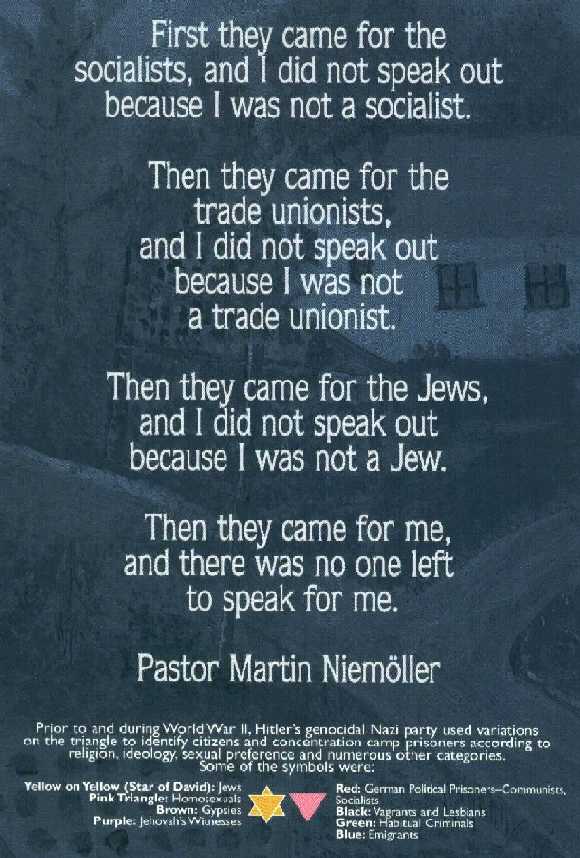
Except, I was brought up to think about more than myself. More than my own family. More than my immediate community. I stand up for others because I know that ultimately if I do not, when I am hurting, no one will stand for me. We learned this lesson through centuries of persecution as Jews.

*******

Students across this nation have taken stands against their universities for accepting money from corporations and individuals representing interests that are antithetical to the institution's mission. Most recently UW-Madison students protested sweatshop labor and got the UW to end participation in the Fair Labor Association. Students have held sit-ins, hunger strikes, stormed chancellors' offices, etc.

Abiding by principles means doing without money rather than taking money from those who seek to hurt you and those you care about. It's rare that the harm is clear and explicit and easy to recognize-- it's often framed as an "unintended consequence" down the road and left for generations to remedy. It's incumbent upon us to be proactive.

Throughout these discussion try and engage in pragmatic idealism. You'll find it life-changing.

I'll say more about pragmatic idealism at my talk in the Wisconsin Idea Room, Education Building, EPS Conference, tomorrow, 10:45 am. See you then.

Advocates for Whom?


The Badger Advocates formed this week to make sure the New Badger Partnership (NBP)--complete with split from the University of Wisconsin System--is passed in the Guv's budget this summer. Thank goodness someone is really digging into who these guys are -- this is a must read.

My question is this: I have heard plenty of folks argue this is great for the research enterprise at UW-Madison. I have no doubt that's true. I've also heard some who think it's good for faculty. And plenty who think it's good for alumni. I also hear from current students who *think* it's good for them. But how, exactly?

How does hiring 72 new faculty benefit students if teaching experience is not a requirement for hiring? If we continue to make tenure decisions based primarily on activities that don't involve students? Where is the evidence that any of the things we are dumping money into are causing improvements either in graduation rates, time-to-degree, gaps in degree completion and/or measured learning gains? Inquiring minds want to know. I've been pointed to the MIU website and told we're working on "quality." That's not enough when the case is being made that doing the one thing we ARE known for--serving as the flagship of a great public university system--is being taken away from the other 140,000 undergraduates and prospective undergraduates across Wisconsin.

Happening This Week


Dear readers,

I want to personally invite you all to attend two terrific events happening on the UW-Madison campus this week. I will be speaking at both and hope to see many of you there.

On Tuesday and Wednesday, the Department of Educational Policy Studies will be holding its annual conference. The topic is The Obama Education Agenda: Principles, Policies, and Prospects.

The speaker for the opening session, Tuesday night at 7 pm at the Union Theater, is none other than Diane Ravitch. (You can bet Liam is excited!) She will be talking about "The Future of Public Education."

On Wednesday there will be several panels and a lunchtime session featuring former Wisconsin congressman David Obey. You might've seen the video of Dave attempting to get into the Wisconsin State Capitol building recently -- I sure hope he talks about that. Take a look at the full agenda, and note that the title for my talk has been revised -- I will now be speaking on Saving Public Higher Education for the Twenty-First Century: The Case for Pragmatic Idealism.

In addition, Wednesday night there will be a teach-in about the New Badger Partnership-- Chancellor Biddy Martin's vision for our public flagship. It will take place from 7-9 pm in Humanities room 2650. Panelists include: Steve Stern: Associate Vice Provost for Faculty and Staff Programs, Chad Goldberg: Associate Professor in the Sociology Dept. and Vice President, United Faculty & Academic Staff (UFAS), AFT 223, and Ben Manski: Executive Director of the Liberty Tree Foundation for the Democratic Revolution.

There's plenty to do around here and a great need to get involved. Come join us!

Why Can't Democratic Leaders Break It Down Like Jon?


Jon Stewart makes a compelling defense of teachers on the March 3rd Daily Show. He juxtaposes numerous comments made on Fox News during the 2010 debate in favor of extending the Bush tax cuts for couples earning more than $250,000 against the "avarice" of teachers earning around $50,000 a year plus benefits here in Wisconsin.

As one Fox anchor put it: "250,000 dollars is not rich for a family of four sending kids to college! It's actually close to poverty!" Indeed. Further, Tracy Byrnes, a "Fox business contributor," railed against reducing pay or rescinding bonuses for Wall Street CEOs whose firms were being bailed out by the U.S. government because of contractual obligations. But, recently, she favored reducing teacher pay and benefits regardless of whether they were promised under existing employment contracts. What's fair is fair -- or not.

Very interesting. The Republican argument is that we shouldn't -- and didn't -- let the Bush tax cuts expire on income over $250,000 (an amount only a fraction of Americans earn), but, in Wisconsin anyway, we should reduce the take-home pay for teachers by more than 8%.

Where's the shared sacrifice? Or is that concept outdated in America?

You Call Yourself An Optimist?


"I'm an optimist...tempers will cool." Scott Walker, delivering his big ol' budget speech, 3/1/2011

There are too many important words being co-opted around these parts lately (more on "flexibility" "tools" and "crisis" later).

Optimism is one of them.

Walker, when you rule the world, you cannot begin to know what optimism truly means. Optimism is the faith that good will prevail even when the world seems dead set against you. As the guy on top beating the heck out of us, you don't have a clue what optimism really means. It's us who have to be optimistic -- that, eventually, you will no longer be in charge.

Let's Be Human Together


Being part of history in the making is a powerful thing. It can make you feel like you are--finally--part of something real. And of course you are. The trick is recognizing what you are part of, and responding as a human being.

Remember our dear friend Pinocchio? He was created by a nice guy (Geppeto) who was lonely, insecure, and sought love-- so he made himself a son. Except that in reality, his "son" was a puppet. He wouldn't become a real boy until he developed a conscience, recognized the power of (and reason for) his strings, and in doing so became part of the world. And Gepetto, despite hoping that his puppet would complete him, remained isolated until Pinocchio became a true boy.

Pinocchio's road to developing a conscience was tough. At first, he just tried to act like he had a conscience. "I've got no strings, to hold me down, to make me fret, or make me frown...there are no strings on me...I want the world to know, nothing ever worries me..."

He enjoyed the help of his friend Jiminy Cricket who tried to remind him that he needed to get a conscience. But time and again, he'd fail to make the right decision, and inevitably forfeit his ability to control his own fate. In an effort to teach him morality, the Blue Fairy came and made Pinocchio's nose grow and grow, until it eventually fell off. She told him "A boy who won't be good might as well be made of wood."

But the story sticks with the puppet, and he get a second, third, even fourth chance to figure out the difference between right and wrong. Gepetto can't teach him--after all, his moral conscience is clearly underdeveloped or he wouldn't have been so self-indulgent as to try and create another person simply to satisfy his own desires.

Eventually, as we know, Pinocchio figures it out. Dreams don't come true when you wish on a star, or try to take a self-serving shortcut: they only come true when you can tell right from wrong.

In today's world, morality is not at all abstract. It is the difference between selfishness and selflessness. Behaving in a moral fashion may hurt in the short-term, but in the long run it's the only way to avoid being exploited, to maintain a community, and to be truly human.

Be brave. Be truthful. Be unselfish.

It's the Wisconsin Idea.